What is an intermediate bulk container?
An intermediate bulk container (IBC) is a reusable industrial container for liquids or bulk solids, sized between a drum and a tank, built to be moved by forklift and, in the US, legally an IBC up to 3 cubic metres (793 gallons).
Last reviewed 2026-11-14.
Between a drum and a tank
The "intermediate" is about size. A 55 gallon drum is the classic small container; a tank truck or a storage tank is bulk. An IBC sits between them: most hold 275 or 330 gallons, and the type runs from about 110 gallons up to 793 (IPS News, IBC volumes). The ceiling comes from the hazmat rules: a rigid IBC keeps its classification up to 3 cubic metres, and a larger container is regulated as a portable tank.
The common 275 gallon tote holds what five drums do and the 330 holds six, on roughly the floor space of 1.25 and 1.5 drum pallets (IBCTanks.com). That is most of the reason plants moved from drums to totes: fewer containers to fill, label and handle, and one forklift trip instead of several.
The three builds
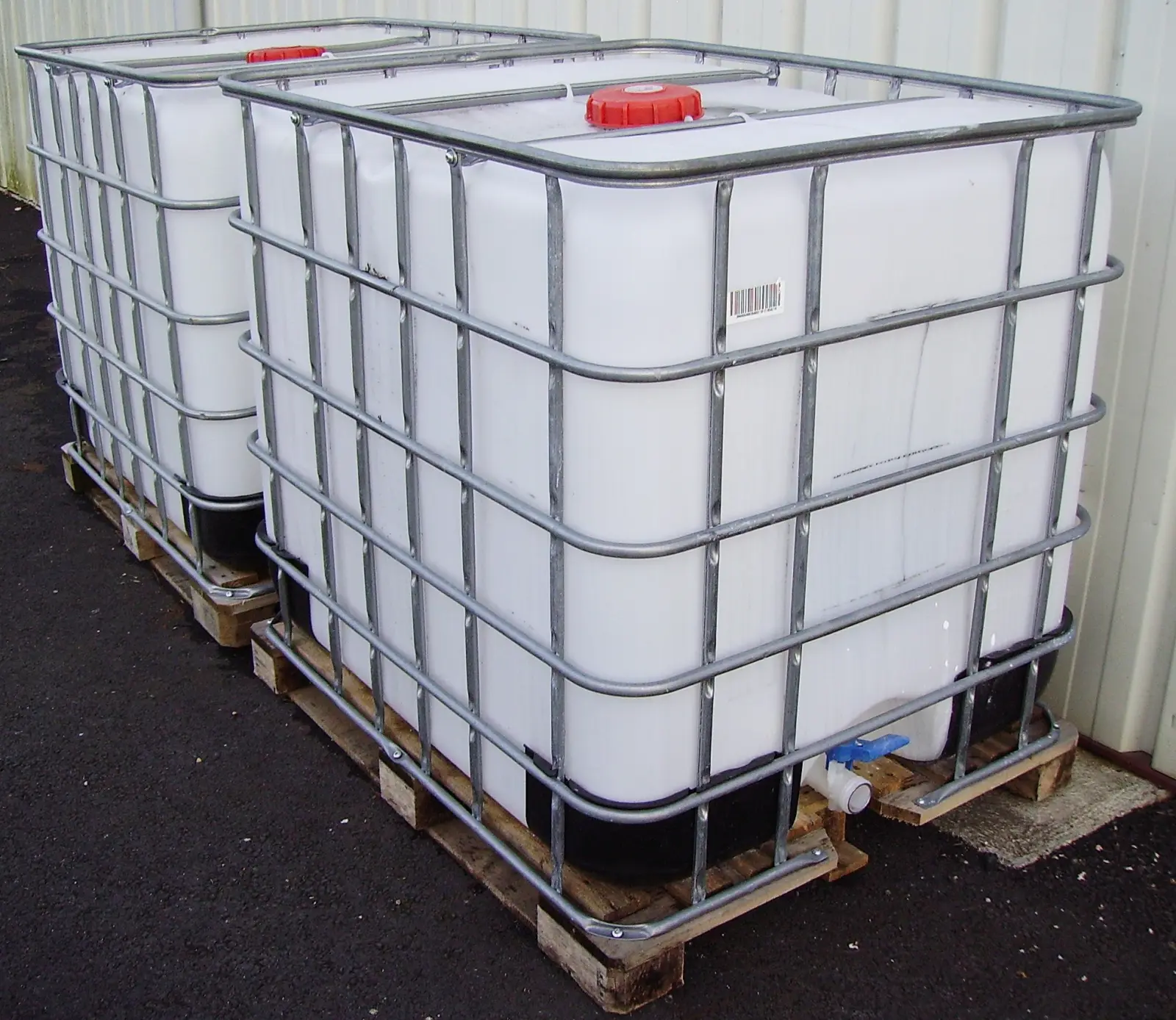
Composite (caged) totes. A rigid HDPE bottle inside a galvanized steel cage on a pallet. The rule for composite IBCs says the outer packaging is designed to bear the entire stacking load and the inner receptacle is not meant to contain the product without it (49 CFR 178.707). This is the tote most people picture, coded 31HA1, and the one most liquid moves in. See caged composite totes.
Rigid plastic IBCs. A single moulded plastic body, freestanding or with structural equipment, coded 31H1 or 31H2 (49 CFR 178.706). The plastic has to resist ageing and ultraviolet light, usually with carbon black or another pigment. See all-plastic or caged composite.
Metal IBCs. Stainless or carbon steel (or aluminium) bodies, coded 31A for steel, 31B for aluminium and 31N for other metals (49 CFR 178.705). They cost and weigh more, last for years of refills and are the IBC choice for Class I flammable liquids. See stainless steel IBCs.
There are also flexible IBCs, the woven bulk bags used for powders and granules, and bag-in-box units with a liner in a cardboard crate for single trips. Neither is what we supply.

What goes in them
Almost any liquid a plant buys or sells in volume: chemicals, solvents, detergents, adhesives, oils and lubricants (Wikipedia, IBC), and in food plants syrups, oils, juice concentrates and flavourings. Farms use them for water, liquid fertilizer and feed supplements. The build follows the product. A UN-rated composite tote suits most regulated liquids up to Packing Group II. A food-contact bottle with no history suits ingredients. A steel IBC suits flammables and long refill service. No IBC may carry a Packing Group I liquid (49 CFR 173.35(j)).
Reading the code on one
Every IBC built for hazmat carries a code that names its build. The two digits say what it holds and how: 11 and 21 are for solids (by gravity, or under pressure), 31 is for liquids. The letters name the materials: A for steel, B for aluminium, H for plastic, and so on. A composite IBC uses two letters, inner then outer, so 31HA1 is a liquid IBC with a plastic inner receptacle and a steel outer packaging (49 CFR 178.702). The full plate is explained in reading the UN marking.
Why plants moved from drums to totes
A caged tote replaces five or six 55 gallon drums on the same pallet footprint, with one valve instead of five bungs, and empties completely through its sloped base. Fewer containers mean fewer labels, fewer lifts and less residue left behind. Drums still make sense for small volumes, for products that must be sealed in small lots, and for customers who handle everything by hand.
Flexible IBCs
Not every IBC is rigid. Flexible IBCs, the woven bulk bags with lifting loops used for powders and granules, are IBCs too, coded 13 rather than 11, 21 or 31. They are a different product from the totes on this site, which are rigid IBCs for liquids.
Short answers
- What does IBC stand for?
- Intermediate bulk container: a reusable container sized between a drum and a tank.
- How big is an IBC?
- Most hold 275 or 330 gallons on a 48 x 40 in base. The type runs from about 110 gallons to 793 gallons, the 3 cubic metre limit for a rigid IBC.
- Is an IBC the same as a tote?
- In the US trade, "tote" usually means the caged composite IBC. Strictly, every tote is an IBC but not every IBC is a tote: steel and flexible IBCs are IBCs too.
- What does IBC stand for?
- Intermediate bulk container: intermediate because it sits between drums and tanks in size.
- Is a tote the same as an IBC?
- In everyday US use, "tote" means a caged composite IBC for liquids. Strictly, totes are one kind of IBC.
- Who makes IBCs?
- Several large packaging companies and many smaller ones make IBCs worldwide. Makers are named on the plate and the bottle.
The totes this bears on
- Caged composite IBC totes, newA new HDPE bottle in a new galvanized steel cage on a new pallet: how a caged composite tote is built, rated and fitted, and the sizes it comes in.Bottle: HDPE · Cage: Galvanized steel · UN code: 31HA1 · Sizes: 135, 275, 330 gal
- New 275 gallon IBC toteThe new 275 gallon caged IBC tote: 48 x 40 in footprint, about 46 in tall, UN31HA1/Y, valve and gasket options. Request a delivered quote.Capacity: 275 gal / 1,040 L · Footprint: 48 x 40 in · Height: about 46 in · UN code: 31HA1/Y
- New 330 gallon IBC toteThe new 330 gallon caged IBC tote: same 48 x 40 in footprint, about 53 to 54 in tall, UN31HA1/Y. Specs, weight and a delivered quote.Capacity: 330 gal / 1,250 L · Footprint: 48 x 40 in · Height: 53 to 54 in · Tare: about 155 lb
- Stainless steel IBC totesNew 304 stainless IBCs in 350 and 550 gallons and up: gauge, finish, UN31A, tare and gross weights, fittings. Quoted on request.Steel: 304, 10 gauge · Finish: 2B · UN code: 31A · Sizes: 350, 550, 793 gal
Read next: Reading the UN marking, Choosing a size, Plastic or composite.