Collecting rainwater in a new tote
One inch of rain on 1,000 square feet of roof yields about 600 gallons, so a single 275 or 330 gallon tote fills from a modest roof in one good rain; screen every opening against mosquitoes, and use the water for gardens and livestock, not drinking.
Last reviewed 2026-11-14.
Sizing from your roof
The rule of thumb is 0.62 gallon per square foot of roof per inch of rain, and real systems catch 75 to 85 percent of that (Texas Water Development Board). UF/IFAS puts it as about 600 gallons from one inch on 1,000 square feet (UF/IFAS).
| Roof area draining to the tote | Caught from 1 in of rain (at 80%) | Totes it fills |
|---|---|---|
| 500 sq ft | about 250 gal | most of one 275 |
| 1,000 sq ft | about 500 gal | one 330 and over half a 275 |
| 2,000 sq ft | about 990 gal | three 330s |
Totes can be linked at the valves with a manifold so several fill and drain together.
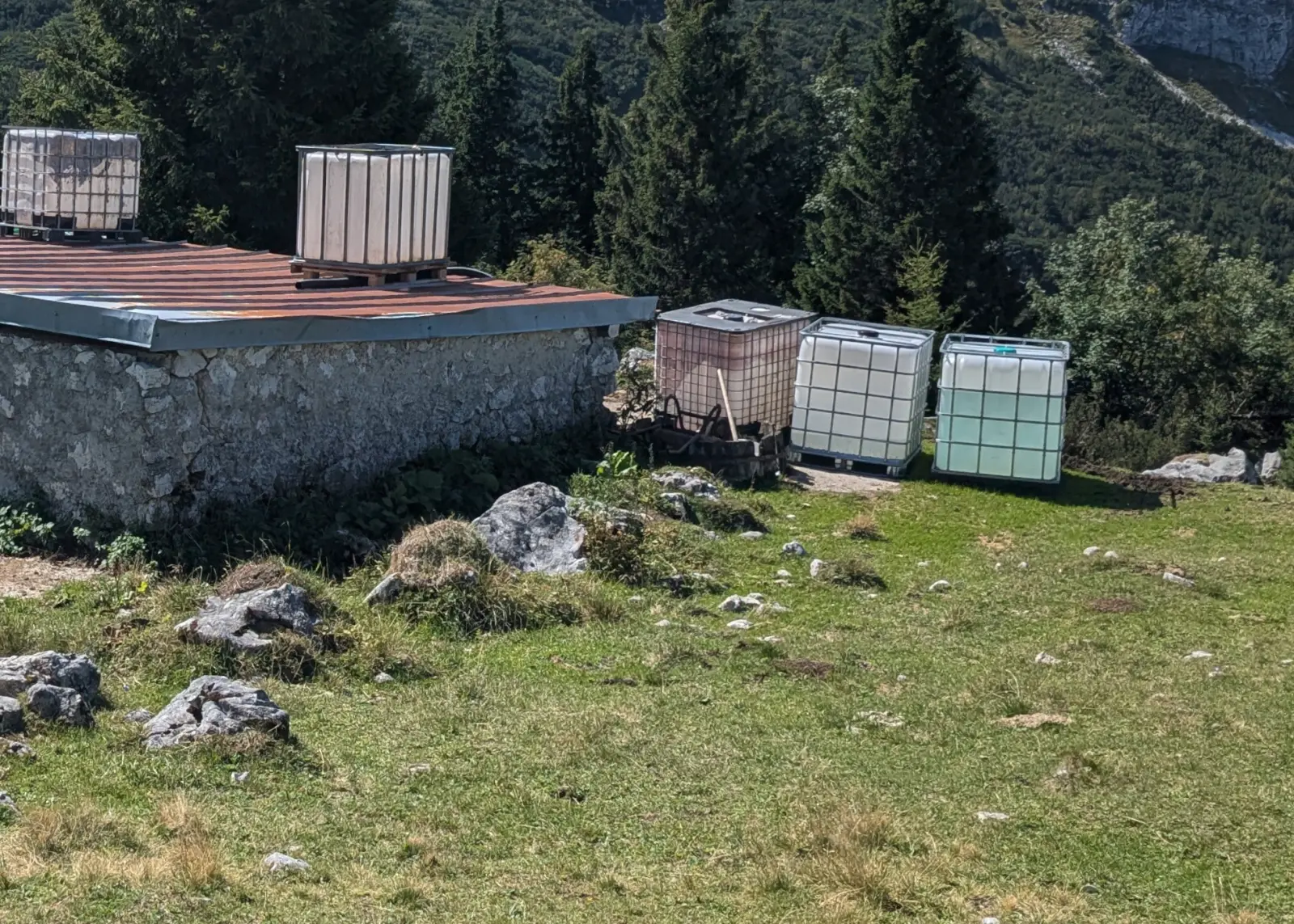

Screens and covers
Stored water draws mosquitoes. Screen every opening, the inlet from the downspout and any vent, with fine mesh, as UF/IFAS advises for rain storage. A first-flush diverter on the downspout keeps the dirtiest first runoff off the roof out of the tote. Cover a natural white bottle or ask for a UV-blocking one: sunlight through the wall grows algae.
Why new matters here too
Garden and livestock water doesn't need a food-contact bottle by any rule, but it does need a bottle with nothing in its past. A used tote that held a herbicide, a solvent or a cleaning chemical can leach traces into the water you put on vegetables or in a trough. A new tote ends the question. If you are building a small system, one new tote is often worth more than three used ones of unknown history.
Not for drinking
Roof runoff carries bird droppings, dust and whatever the roof is made of. UF/IFAS says stored rainwater is not for drinking. Treating rainwater to drinking standard is a separate system with filtration and disinfection. For stored drinking water, fill a food-contact tote from a treated supply; see a new tote for drinking water.
Connecting the tote
Bring the downspout to the tote through a screened inlet in the top opening or a fitting cut into the lid. A first-flush diverter on the downspout sends the dirtiest early rain away before the tote fills. Add an overflow near the top, piped away from the house foundation, so a full tote doesn't spill over the cap. A second tote can be linked at the valves with a short hose to share the water between them.
Raise the tote on a level, firm base of blocks or a stand so a watering can or a hose fits under the outlet and gravity gives some pressure. A full 275 weighs about 2,400 lb, so the base must be built for it. Drain the tote and leave the valve open before a hard freeze; ice can split the bottle and the valve.
Rules where you live
Most US states allow rain harvesting from roofs, and some encourage it with guidance and rebates; a few have limits on how much may be stored or how it may be used. Check your state's water agency and your city before you install, especially in the West. Texas, for example, publishes guidance for homeowners and businesses (Texas Water Development Board).
Short answers
- How much rain fills a 275 gallon tote?
- A little over half an inch of rain on 1,000 square feet of roof, at the usual 75 to 85 percent capture.
- How do I keep mosquitoes out of a rainwater tote?
- Screen every opening with fine mesh and keep the cap closed except for a screened inlet.
- Can I drink rainwater from a tote?
- Not untreated. UF/IFAS says stored rainwater is not for drinking.
- Do I need a pump for a rain tote?
- Not for a watering can or a soaker hose: gravity from a raised tote is enough. A pump helps for sprinklers or long hose runs.
- How do I stop algae?
- Keep light out: use a dark bottle, paint the cage panels, or cover the tote. A screened lid also keeps leaves and insects out.
- Will the water smell?
- Water left warm and still with leaves in it can turn sour. Clean the gutters, use a first-flush diverter, and use the water regularly.
- Can I connect several totes?
- Yes, at the valves with short hoses or a manifold, so they fill and drain together. Set them level on the same base.
- Can rainwater go on vegetables?
- Many gardeners use it on soil around food plants. Avoid splashing leaves you will eat raw, especially from roofs with old or treated materials, and follow your extension service’s advice.
- How do I winterise a rain tote?
- Disconnect the downspout, drain it completely, leave the valve open, and cover the top so snow and debris stay out.
The totes this bears on
- New totes for water storageA new 275 or 330 gallon tote with no chemical history for drinking, livestock or rain water: sizes, what to check and a quote.Sizes: 275 and 330 gal · Bottle: new, food-contact on request · Full weight: about 2,400 lb (275) · Footprint: 48 x 40 in
- New 275 gallon IBC toteThe new 275 gallon caged IBC tote: 48 x 40 in footprint, about 46 in tall, UN31HA1/Y, valve and gasket options. Request a delivered quote.Capacity: 275 gal / 1,040 L · Footprint: 48 x 40 in · Height: about 46 in · UN code: 31HA1/Y
- New 330 gallon IBC toteThe new 330 gallon caged IBC tote: same 48 x 40 in footprint, about 53 to 54 in tall, UN31HA1/Y. Specs, weight and a delivered quote.Capacity: 330 gal / 1,250 L · Footprint: 48 x 40 in · Height: 53 to 54 in · Tare: about 155 lb
- Food-grade new IBC totesNew totes with food-contact HDPE bottles (21 CFR 177.1520) and no prior contents, for syrups, oils and ingredients. Specs and a quote.Bottle resin: 21 CFR 177.1520 · Prior contents: None · Gaskets: EPDM or Viton · Sizes: 275, 330 gal
Read next: Drinking water, Caps, lids and vents, Camlock or NPT.