Valves and fittings on a new tote
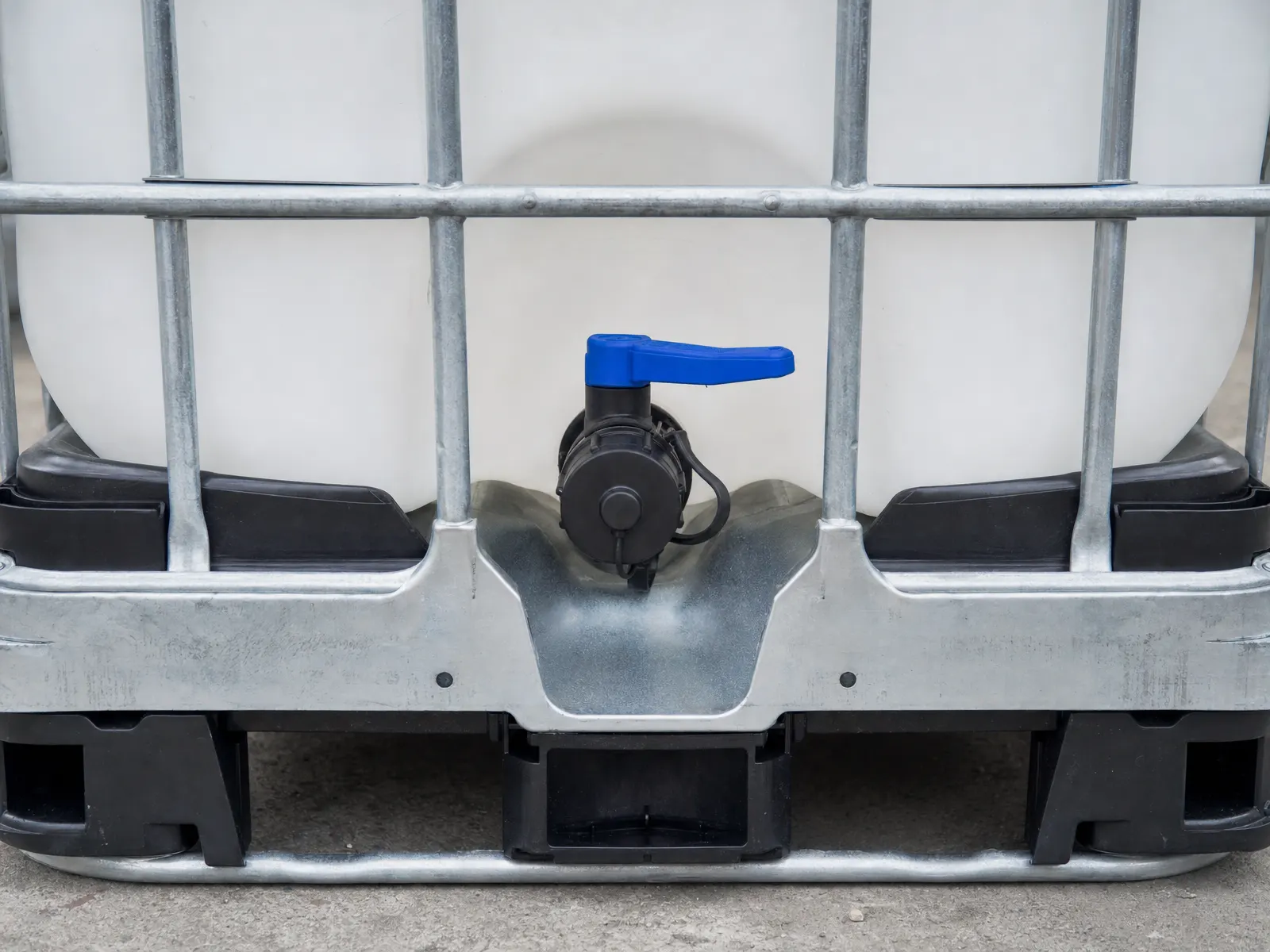
Most new caged totes drain through a 2 in butterfly or ball valve at the foot of the bottle, with a threaded outlet that takes a camlock or NPT adapter and gaskets in EPDM or Viton; all four choices should be set to match your product and your line before the order.
Last reviewed 2026-11-14.
The four choices
Valve type. A butterfly valve has a disc that turns a quarter turn across the bore; a ball valve has a ball with a hole through it. Both are quarter-turn. Some designs use other types. See butterfly, ball or cylinder valve.
Size. 2 in (DN50) is the common bore; 3 in (DN80) drains faster and suits viscous products. See 2 in or 3 in outlet.
Outlet connection. The valve's outlet is threaded. An adapter on it gives a camlock (quick-connect) or an NPT thread to match your hose or pipe. See camlock or NPT.
Gasket material. The seals in the valve and the cap touch the product. EPDM and Viton (FKM) are the usual two.
Butterfly. A disc turns a quarter turn in the bore. Simple, and the usual 2 in valve on a caged tote.
Ball. A drilled ball turns to line its hole up with the bore. Opens fully straight through, so thicker product drains well.
EPDM or Viton
| EPDM | Viton (FKM) | |
|---|---|---|
| Usually good with | Water, many water-based products, dilute acids and alkalis, glycols | Oils, fuels, many solvents and acids |
| Usually poor with | Oils, fuels and hydrocarbon solvents, which swell it | Some ketones, esters and amines |
| Cost | Lower; standard on many totes | Higher |
This is a general guide, not a compatibility chart. Your product's supplier or the gasket maker's chart has the final word; tell us the product and we'll quote the gasket that suits it. Food plants also need a food-contact compound; say so on the request.
Fittings that keep the tote sealed
A new tote ships with a dust cap or plug over the valve outlet, and the fill cap has a tamper-evident band on many designs. Keep both on until the tote is at the filling or drawing station: the dust cap keeps grit out of the valve seat, the band shows the cap hasn't been opened since it left the plant. Under the inspection rules, service equipment (the valve, cap and any vents) has to work and be free of damage that could cause failure (49 CFR 180.352(b)(2)).
What to put on the request
Valve type and size, the outlet connection your hose or pipe uses (with its size and gender), the gasket material, and the product. If you don't know the connection, a photo of the hose end on your current totes is enough; we'll match it. Changing fittings after delivery is possible but costs time and a few parts, and every joint you add is one more place to leak.
Matching a new tote to your line
If your plant already runs totes, the simplest way to get the fittings right is to copy what works. Look at the valve on a tote you are using now and note four things: the valve type (a lever on a disc is a butterfly; a quarter-turn handle on a ball is a ball valve), the nominal size, the outlet (a coupling with cam arms, or a male or female thread) and the gasket colour or marking. Photograph the outlet with a tape measure across the face.
Send that photo with your request and we will match it. If your hose or pump is the fixed point, measure that instead: the inside diameter of a hose barb or the outside diameter of a threaded nipple tells us the size, and the number of threads per inch tells us the thread. For a new line with nothing fixed yet, a 2 in valve with a 2 in camlock outlet is a common pairing on caged totes, and adapters for it are easy to find.
Short answers
- What size is the valve on an IBC tote?
- Usually 2 in (DN50). Some totes take a 3 in (DN80) valve for faster draining.
- What is the thread on an IBC tote valve?
- It varies by design. Many totes use a coarse thread on the valve outlet and an adapter to camlock or NPT. Tell us what your hose takes and we fit the adapter.
- Which gasket for oil?
- Viton (FKM) is the usual choice for oils and fuels; EPDM swells in them.
- Can I change the valve on a tote myself?
- On many designs the valve unscrews from a flange on the bottle, but a valve change on a UN-rated tote used for hazmat may count as a repair under the rules. Order the valve you need fitted new.
- What is a dust cap for?
- It covers the outlet so dirt, insects and moisture stay out of the valve between uses and in transit, and it catches drips.
- Do valves come with a tamper seal?
- Many can be sealed with a numbered tag through the handle. Ask on the request.
The totes this bears on
- New 275 gallon IBC toteThe new 275 gallon caged IBC tote: 48 x 40 in footprint, about 46 in tall, UN31HA1/Y, valve and gasket options. Request a delivered quote.Capacity: 275 gal / 1,040 L · Footprint: 48 x 40 in · Height: about 46 in · UN code: 31HA1/Y
- New 330 gallon IBC toteThe new 330 gallon caged IBC tote: same 48 x 40 in footprint, about 53 to 54 in tall, UN31HA1/Y. Specs, weight and a delivered quote.Capacity: 330 gal / 1,250 L · Footprint: 48 x 40 in · Height: 53 to 54 in · Tare: about 155 lb
- Food-grade new IBC totesNew totes with food-contact HDPE bottles (21 CFR 177.1520) and no prior contents, for syrups, oils and ingredients. Specs and a quote.Bottle resin: 21 CFR 177.1520 · Prior contents: None · Gaskets: EPDM or Viton · Sizes: 275, 330 gal
- UN-rated chemical totesNew UN-rated totes for chemicals: 31HA1/Y codes, specific gravity 1.6 or 1.9, the 2.5-year retest clock, and a quote that asks the right questions.UN code: 31HA1/Y · Packing groups: II and III · Specific gravity: 1.6 or 1.9 · Retest: every 2.5 years
Read next: Butterfly or ball valve, Camlock or NPT, 2 in or 3 in outlet.