A new tote for drinking water
A new tote with a food-contact bottle that has never held anything is a sound container for stored drinking water; CDC advises food-grade containers, never one that held toxic chemicals, and replacing stored water every six months.
Last reviewed 2026-11-14.
Why new, and why food-contact
CDC's guidance on emergency water says not to store drinking water in containers that previously held liquid or solid toxic chemicals, such as bleach or pesticides, and that FDA-approved food-grade containers are best (CDC). A used tote's history is usually chemical, and HDPE can hold traces of what it held. A new tote with a food-contact bottle has no history, so the question doesn't arise.
The cage and pallet don't touch the water. What matters is the bottle's resin, the cap and valve gaskets, and that the tote is new. See food grade or not.
How much a tote stores
CDC suggests storing at least one gallon per person per day for at least three days, and a two-week supply if you can. At that rate one 275 gallon tote holds about 39 person-weeks of drinking water: a family of four for about 69 days. A 330 holds 20 percent more on the same base.

Keeping the water good
Replace it. CDC advises replacing stored water every six months. Drain a tote through the valve to the garden and refill it from a clean, treated supply.
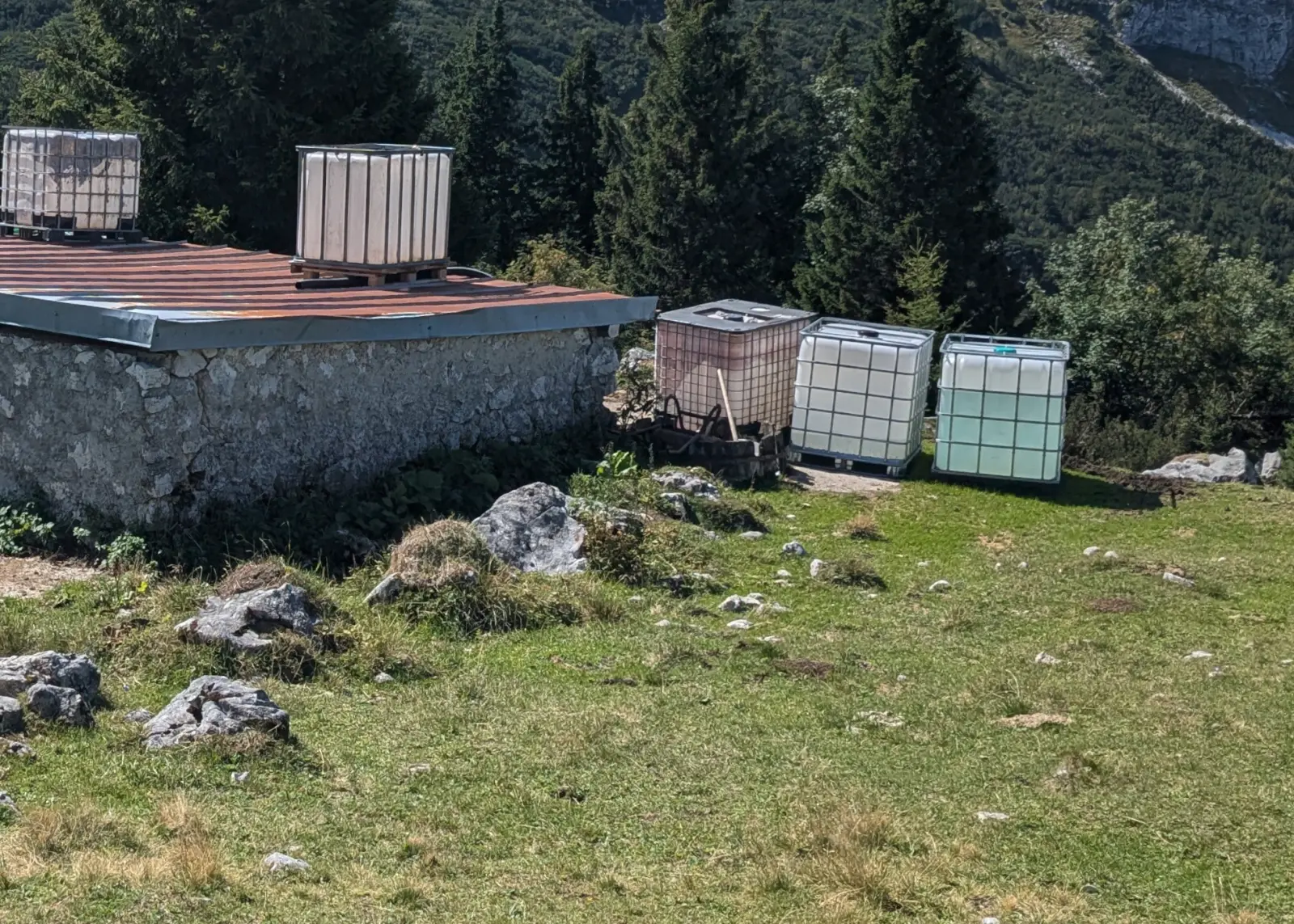
Keep light out. A natural white bottle lets light through, and with light algae can grow. Store it indoors, cover the tote with an opaque wrap or a purpose-made cover, or ask for a UV-blocking bottle if it will stand outside.
Keep the openings closed. Keep the cap tight except when filling, the dust cap on the valve, and a clean hose that is used for nothing else.
Fill clean. Fill from a treated municipal supply or a tested well, through a drinking-water-safe hose.
Where to stand it
Full, a 275 weighs about 2,430 lb on 13.3 square feet. Stand it on a slab or level compacted ground, never a deck or a suspended floor. Leave room in front to reach the valve with a container, or raise it on blocks rated for the load. In freezing climates, keep it from freezing hard: ice expanding in the bottle and the valve can crack them.
Filling and drawing water
Fill from a clean, safe supply with a hose used only for drinking water. Before the first fill, rinse the bottle with clean water. If your supply isn't chlorinated, CDC gives instructions for treating stored water with plain, unscented household bleach (CDC). Close the cap, label the tote with the date it was filled and the date it is due to be changed, and keep the label where you will see it.
Draw water through the bottom valve into clean containers, never by dipping into the top opening. Keep the outlet capped between uses and wipe the outlet before drawing. If the water looks cloudy, smells, or has anything growing in it, don't drink it: empty, clean and refill the tote.
A family or a small office can work out how much to keep from CDC's figure of at least a gallon per person per day: four people for two weeks need 56 gallons, so even a 135 gallon tote stores more than that.
In an emergency
When the tap stops, a stored tote is only useful if you can reach the water. Keep a clean jug or bucket and the valve key by the tote, and know how to drain it into small containers without a pump. If the tote is outdoors and a freeze is coming, move what you can indoors or insulate the valve. If the stored water has gone past its change date, it can still be used for flushing toilets and cleaning while fresh water is found.
Short answers
- Can I store drinking water in a used tote?
- Not one that held chemicals. CDC advises food-grade containers that never held toxic chemicals. A new food-contact tote is the clean choice.
- How long can I keep water in a tote?
- CDC advises replacing stored water every six months.
- Should a water tote be black?
- A black or UV-blocking bottle, or an opaque cover, keeps light out and slows algae if the tote stands outside.
- Can I store drinking water in a tote outdoors?
- Yes, if the tote is shaded or covered to keep light off the bottle and slow algae, kept off bare ground, and protected from freezing.
- Should the bottle be clear or dark?
- A darker or opaque bottle, or a cover over a natural one, keeps light out and slows algae; a natural bottle lets you see the level.
- Can I use a tote that held juice or syrup?
- Only if you know exactly what it held and can clean it thoroughly, and even then a new tote removes the doubt.
- How do I clean a tote before refilling?
- Drain it, rinse well, wash with a mild detergent solution, rinse again, and sanitise as CDC describes before refilling with safe water.
- Will water from a plastic tote taste odd?
- Fresh water from a new food-contact bottle may taste slightly of plastic at first. Rinse and refill once, and keep it cool and dark.
- Is a tote safe for babies’ formula water?
- For infant formula, follow the guidance of your doctor and local health officials on water sources and treatment.
The totes this bears on
- New totes for water storageA new 275 or 330 gallon tote with no chemical history for drinking, livestock or rain water: sizes, what to check and a quote.Sizes: 275 and 330 gal · Bottle: new, food-contact on request · Full weight: about 2,400 lb (275) · Footprint: 48 x 40 in
- Food-grade new IBC totesNew totes with food-contact HDPE bottles (21 CFR 177.1520) and no prior contents, for syrups, oils and ingredients. Specs and a quote.Bottle resin: 21 CFR 177.1520 · Prior contents: None · Gaskets: EPDM or Viton · Sizes: 275, 330 gal
- New 275 gallon IBC toteThe new 275 gallon caged IBC tote: 48 x 40 in footprint, about 46 in tall, UN31HA1/Y, valve and gasket options. Request a delivered quote.Capacity: 275 gal / 1,040 L · Footprint: 48 x 40 in · Height: about 46 in · UN code: 31HA1/Y
- New 330 gallon IBC toteThe new 330 gallon caged IBC tote: same 48 x 40 in footprint, about 53 to 54 in tall, UN31HA1/Y. Specs, weight and a delivered quote.Capacity: 330 gal / 1,250 L · Footprint: 48 x 40 in · Height: 53 to 54 in · Tare: about 155 lb
Read next: Rainwater, Food grade or not, Caps, lids and vents.