Caps, lids and vents on a tote
A new caged tote is filled through a large screw cap on top of the bottle, commonly 6 in (150 mm) across, and the cap can be plain, vented or fitted with a smaller bung; a product that gives off gas or a tote drained without another air inlet needs a vent.
Last reviewed 2026-11-14.
The fill cap
The cap sits in the middle of the bottle's top, between the cage bars. On many designs it is 6 in across; one new 330 gallon listing names a 6 in top screw cap (Cary 26WN3C). Some designs use a larger opening. It screws on by hand or with a cap wrench and seals on a gasket, which, like the valve's, should suit the product. Many caps also carry a smaller threaded bung, often 2 in, for a vent, a dip tube or a fill line, so the main cap can stay shut.
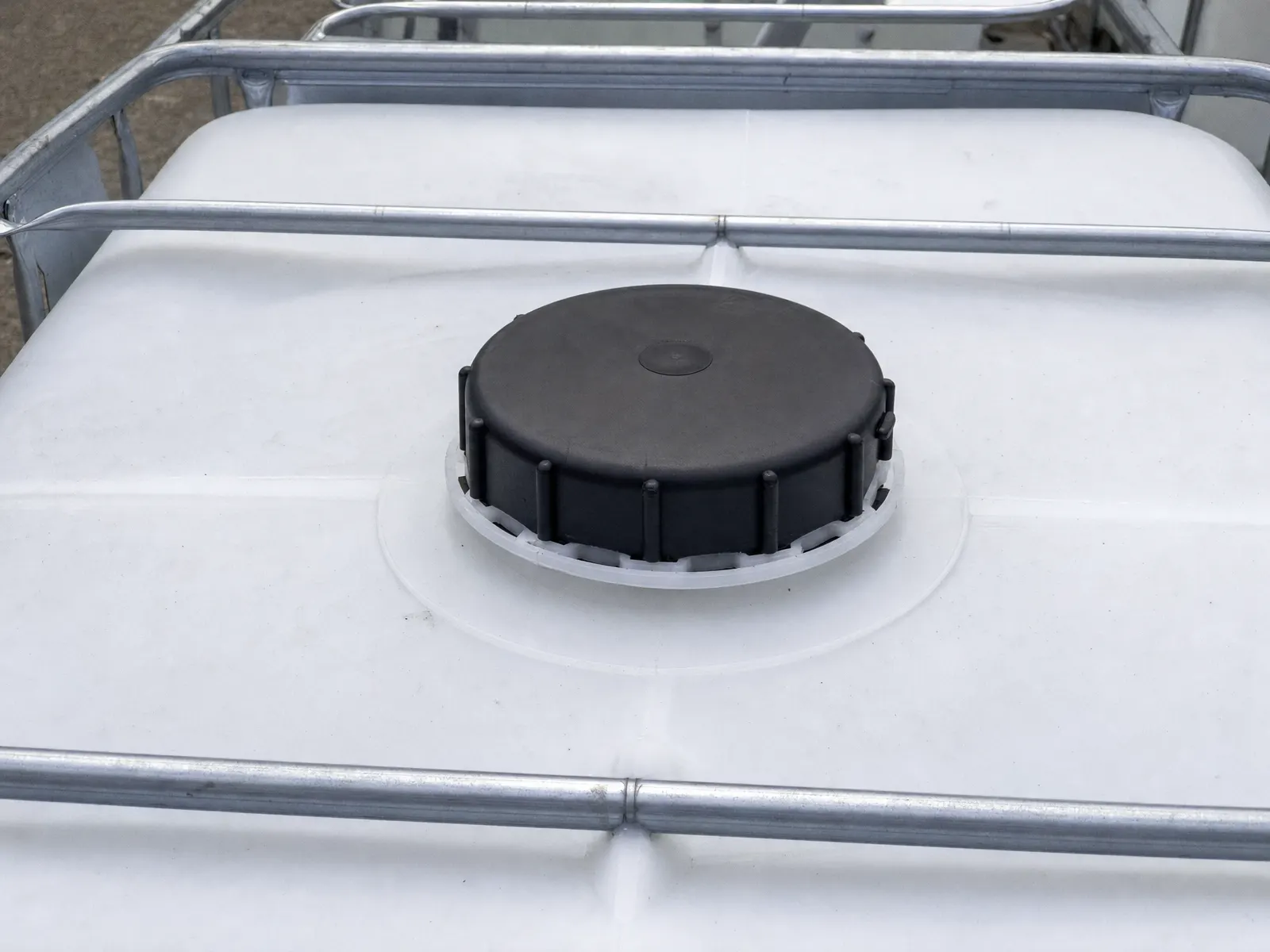
Vented or not
A tote has to breathe in two situations.
When draining. Every gallon that leaves through the valve has to be replaced by air. With the cap tight and no vent, the bottle pulls in, flow slows to a glug and a thin-walled bottle can deform. Loosen the cap or open a vent before you drain.
When the product gives off gas or warms up. Some products release gas as they sit: peroxides, some fermenting food products and some cleaning chemicals. Any liquid expands when it warms. A vented cap with a pressure-relief element lets that out without letting product or rain in. The rule for rigid plastic IBCs already requires the body to release enough vapour to avoid rupture if pressure rises past what it was tested to (49 CFR 178.706(c)(4)); a vented cap is the everyday way to keep it from getting there.
A product that must not take in moisture or air should have an unvented cap, and the vent should be opened only while draining.
Tamper bands and seals
New totes usually arrive with the cap closed and a tamper-evident band or seal on it. For food, pharmaceutical and chemical buyers, an unbroken band is a quick check that nothing has been opened since the tote left the plant. Keep it on until filling. After filling, many shippers add their own seal so the receiver can check the same thing.
For rainwater and water storage
On a water tote the opening at the top is how mosquitoes and debris get in. UF/IFAS advises screening every opening on rain storage (UF/IFAS). A screened inlet in the cap, or a fine mesh under a loosened cap, does it. See rainwater totes.
Filling through the top
Most totes are filled through the top opening with a hose or a fill lance. A lance that reaches near the bottom of the bottle fills with less splashing and less foam, which matters for detergents, some syrups and anything that gives off vapour as it falls. Bottom filling through the valve is possible on some lines, but the valve and outlet then see the full fill pressure, so check the maker's guidance.
When the tote is full, wipe the cap threads before closing, so a ring of dried product doesn't stop the cap seating. Tighten to the maker's figure if one is given; a cap wrench gives more even torque than a hand and a hammer. Fit a new seal if the shipment goes to a customer, and record its number on the paperwork.
Opened totes in a plant should be capped between uses. An open fill port lets in dust, insects and moisture, and on a tote of solvent or concentrate it lets vapour into the room.
Spare caps and seals
Caps crack, threads cross and seals get lost. Keep a few spare caps of the right size and thread, and a box of the seals your customers expect. A cap from another maker may look the same and still not seat, so match the replacement to the tote's own design.
Short answers
- What size is an IBC tote lid?
- Commonly 6 in (150 mm) across the screw cap. Some designs use a larger opening.
- Why does my tote glug when I drain it?
- Air can’t get in to replace the liquid. Loosen the cap or open the vent bung.
- Do I need a vented cap?
- If the product gives off gas, warms up in storage or the tote is drained without another air inlet, yes. A product that must stay sealed should have an unvented cap.
- Can I get a tote with a larger top opening?
- Top openings vary by design. If you need a larger one for cleaning or adding solids, say so on your request and we will look for a design that has it.
- Can I drill a hole in the lid for a hose?
- For a rain or water tote, yes, with a smooth-edged hole and a screen. Never modify the cap of a tote used for regulated product.
The totes this bears on
- New 275 gallon IBC toteThe new 275 gallon caged IBC tote: 48 x 40 in footprint, about 46 in tall, UN31HA1/Y, valve and gasket options. Request a delivered quote.Capacity: 275 gal / 1,040 L · Footprint: 48 x 40 in · Height: about 46 in · UN code: 31HA1/Y
- New 330 gallon IBC toteThe new 330 gallon caged IBC tote: same 48 x 40 in footprint, about 53 to 54 in tall, UN31HA1/Y. Specs, weight and a delivered quote.Capacity: 330 gal / 1,250 L · Footprint: 48 x 40 in · Height: 53 to 54 in · Tare: about 155 lb
- Food-grade new IBC totesNew totes with food-contact HDPE bottles (21 CFR 177.1520) and no prior contents, for syrups, oils and ingredients. Specs and a quote.Bottle resin: 21 CFR 177.1520 · Prior contents: None · Gaskets: EPDM or Viton · Sizes: 275, 330 gal
- New totes for water storageA new 275 or 330 gallon tote with no chemical history for drinking, livestock or rain water: sizes, what to check and a quote.Sizes: 275 and 330 gal · Bottle: new, food-contact on request · Full weight: about 2,400 lb (275) · Footprint: 48 x 40 in
Read next: Valves and fittings, Rainwater, Food grade or not.