Buying new totes by the truckload
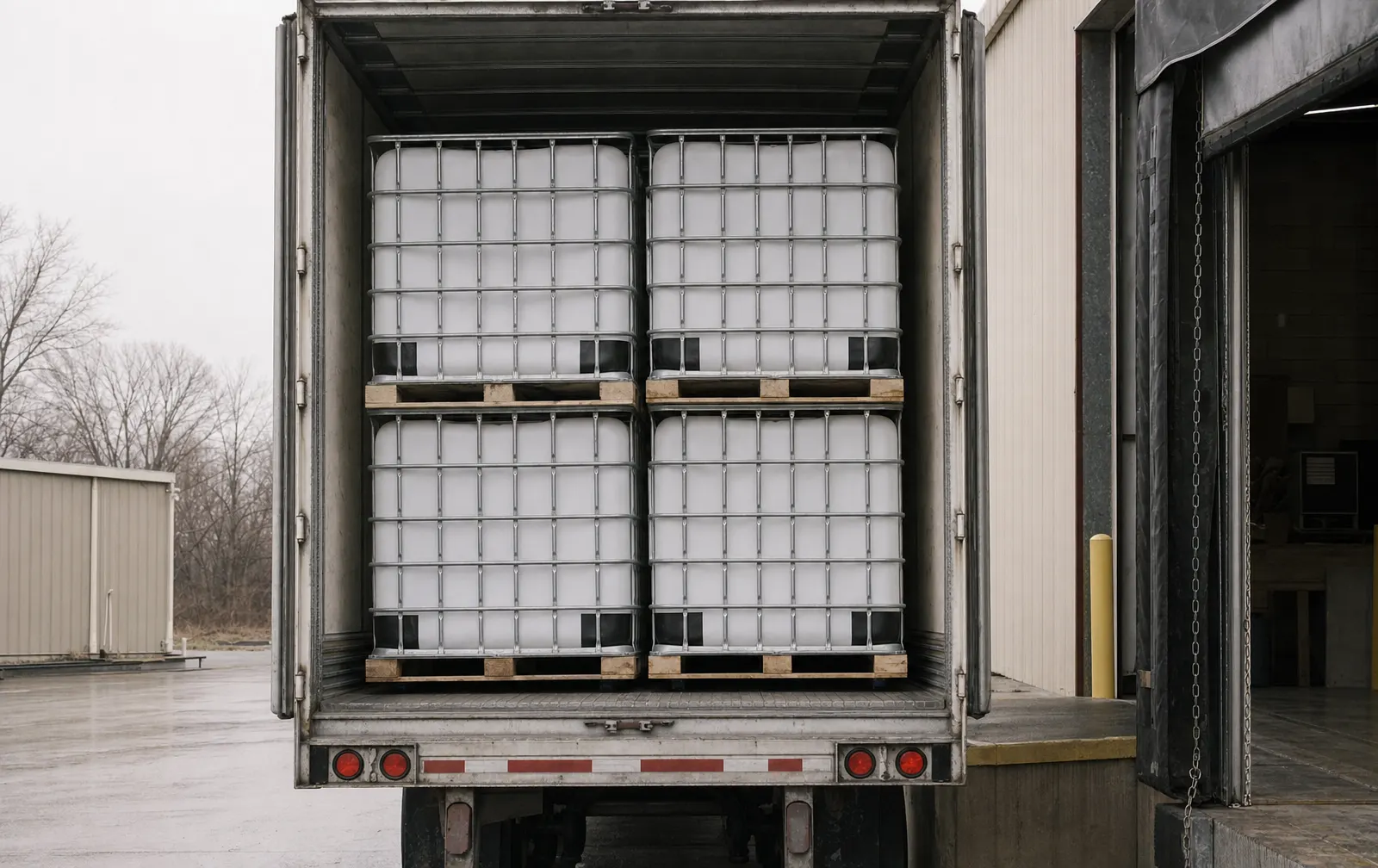
A 53 ft trailer carries 28 to 56 empty 275 or 330 gallon totes depending on whether they ride one or two high, so a full load is usually 28 tote positions doubled; small totes of 110 to 250 gallons go 56 to 84 a load and large 450 to 550 gallon IBCs about 30.
Last reviewed 2026-11-14.
Totes per trailer
| IBC class | Per 53 ft trailer | Gallons a load |
|---|---|---|
| Small, 110 to 250 gal | 56 to 84 | 9,240 to 14,000 |
| Medium, 250 to 350 gal (275 and 330) | 28 to 56 | 7,000 to 19,600 |
| Large, 450 to 550 gal | about 30 | 13,500 to 16,500 |
Figures from IBCTanks.com, which also gives up to 60 IBCs as the most a 53 ft trailer can take. The range for 275s and 330s is one high against two high. Empty totes are light enough that a load of them is limited by floor and height, not weight; empty 275 and 330 totes stack three or four high in storage (Container Exchanger).
How a load arrives
New totes ship empty, closed and capped, standing on their own pallets and usually stacked two high. Each tote's pallet takes forks from four sides, so a standard forklift unloads them at a dock. Plan the floor space before the truck comes: 56 totes stacked two high take 28 pallet positions, about 375 square feet plus aisles. Without a dock, a load this size needs a forklift that can reach into the trailer from the ground, or a different delivery plan; tell us your site.
Planning repeat orders
Work out how many totes you fill in a typical month and how much floor you can give to empties. A plant filling 30 totes a month takes a load about every other month at 56 a load, or one 28-tote load a month if floor space is short. Tell us the rhythm, monthly, quarterly or as needed, and the quote can be set up for it. A steady plan also keeps the date of manufacture on your totes recent, which matters for the hazmat retest clock.
Mixing a load
A load doesn't have to be one tote. 275s and 330s, rated and food-contact bottles, and different valves can share a trailer, as long as the stacking works. Say what mix you need on the request. Steel IBCs are heavier and stack differently, so a load that includes them is planned from their data sheets.
Receiving a full load
A full trailer of totes takes time to unload. Two-high stacks come off a dock with a forklift that can reach into the trailer, one stack at a time; from the ground, a liftgate takes one tote at a time, which is slow for a full load. Plan for the space too: 56 totes stacked two high cover 28 pallet positions, about 375 square feet of floor before aisles.
Check the load before the driver leaves. Count the totes, look for crushed cages, punctured bottles and broken pallets, and note any damage on the delivery receipt. Photographs taken at the dock make a freight claim much easier.
Storing a load until it is used
Empty new totes keep best indoors, or at least under a roof, out of strong sunlight and off standing water. Keep them capped and their valves closed so dust, birds and insects stay out of the bottles. Stack only as high as the maker allows for empty totes, square on each other, on a floor flat enough that the stacks don't lean.
Use the oldest first. Plates carry the manufacture date, and for hazmat service the retest clock runs from it whether or not the tote has been used, so a tote that sat in a yard for two years has less time left before its first test (49 CFR 180.352). Ordering on a schedule that matches your use keeps that time short.
Short answers
- How many IBC totes fit on a 53 ft trailer?
- 28 to 56 totes of 250 to 350 gallons, depending on whether they ride one or two high. Up to 60 IBCs is the figure given for the most a trailer takes.
- Can I mix 275 and 330 totes on one truck?
- Yes, as long as the stacks pair up. Say what mix you need on the request.
- Do totes need a loading dock?
- A dock is easiest for a full load. Without one, a forklift that can reach into the trailer from the ground is needed, or a liftgate truck for a few totes.
- How much floor does a full load of totes need?
- Stacked two high, 56 totes need 28 pallet positions, about 375 square feet before aisles; one high they need twice that.
- How far ahead should I order a full load?
- Tell us when you need the totes on the request. Repeat buyers who share a usage forecast make scheduling simpler for everyone involved.
- Can a load be split between two of our sites?
- Often, if both are on a sensible route. Give both addresses, the count for each, and their receiving hours, and we will quote it.
- Who unloads?
- The receiver unloads at a dock or from a liftgate truck; drivers generally do not operate your equipment. Have a forklift and an operator ready when the truck is due.
The totes this bears on
- New 275 gallon IBC toteThe new 275 gallon caged IBC tote: 48 x 40 in footprint, about 46 in tall, UN31HA1/Y, valve and gasket options. Request a delivered quote.Capacity: 275 gal / 1,040 L · Footprint: 48 x 40 in · Height: about 46 in · UN code: 31HA1/Y
- New 330 gallon IBC toteThe new 330 gallon caged IBC tote: same 48 x 40 in footprint, about 53 to 54 in tall, UN31HA1/Y. Specs, weight and a delivered quote.Capacity: 330 gal / 1,250 L · Footprint: 48 x 40 in · Height: 53 to 54 in · Tare: about 155 lb
- New 135 gallon IBC toteThe short 135 gallon caged tote: when it beats a 275, what is published about it, how it ships and how to get it quoted.Capacity: 135 gal / about 511 L · Build: Caged composite · Rating: UN Y1.6 or Y1.9 by design · Per trailer: 56 to 84 short IBCs
- UN-rated chemical totesNew UN-rated totes for chemicals: 31HA1/Y codes, specific gravity 1.6 or 1.9, the 2.5-year retest clock, and a quote that asks the right questions.UN code: 31HA1/Y · Packing groups: II and III · Specific gravity: 1.6 or 1.9 · Retest: every 2.5 years
Read next: What goes into a quote, Weight, empty and full, 330 or 275 gallon.