All-plastic or caged composite
A caged composite tote (31HA1) is a thin HDPE bottle carried by a steel cage that takes the stacking load; an all-plastic IBC (31H1 or 31H2) is one thick moulded plastic body that carries itself; the composite is the everyday general-purpose tote, and the all-plastic is chosen where nothing metal should be on the outside.
Last reviewed 2026-11-14.
How they are built
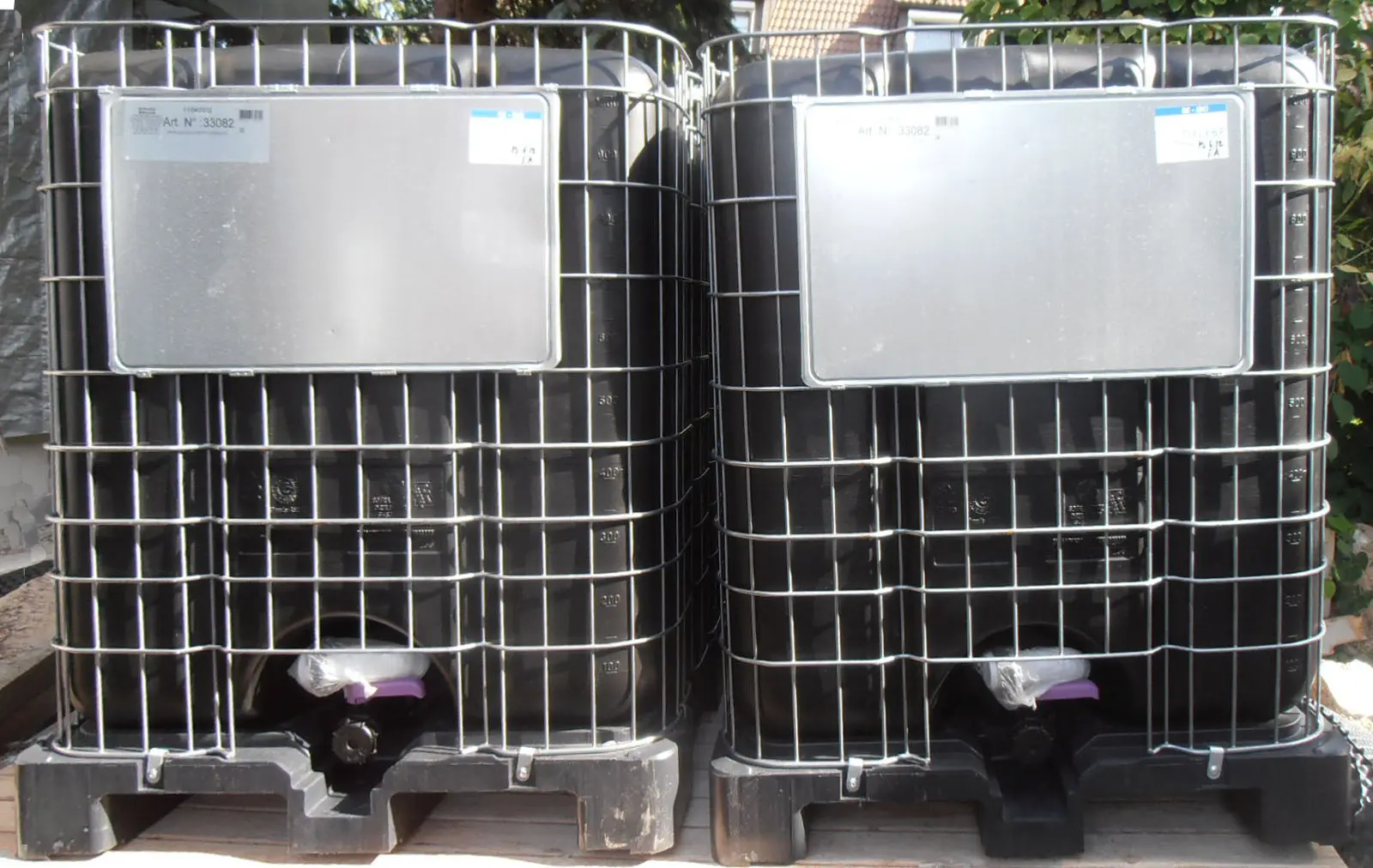
Caged composite. A blow-moulded HDPE bottle sits in a galvanized steel cage on a pallet. Under 49 CFR 178.707 the outer packaging bears the entire stacking load, and the bottle isn't meant to hold the product without it. That lets the bottle be light, and the whole tote weighs about 127 to 155 lb.
All-plastic (rigid plastic). A single body, often rotationally moulded with walls around half an inch thick (IBCTanks.com). It is coded 31H1 when fitted with structural equipment that carries the stacking load, or 31H2 when freestanding (49 CFR 178.706). The plastic must resist ageing and ultraviolet light, usually with carbon black or another pigment.

Where each fits
| Caged composite | All-plastic | |
|---|---|---|
| No metal outside | No: galvanized cage | Yes |
| Corrosive surroundings | Cage can rust over time | Nothing to rust |
| Walls | Thin bottle; the cage carries the load | Thick moulded body carries itself |
| Bottle replaceable | Yes (rebottling) | No: the body is the container |
| Typical use | One-way shipping, general storage, food, water | Corrosive surroundings where a steel cage would rust |
Fire is the same answer
Both are plastic where it matters in a fire. Neither should hold a Class I flammable liquid; for those, the answer is a metal IBC (IBCTanks.com on NFPA guidance). See flammable liquids.
What we supply
We supply new caged composite totes and steel IBCs. We don't supply all-plastic IBCs. If your process needs one, say so when you get in touch and we'll tell you plainly; if a caged tote or a stainless IBC would serve as well, we'll say that instead. For most liquids, a new caged composite tote is the lighter, cheaper and more widely handled choice. Its galvanized cage, when new, has bright zinc and no rust.
Handling and damage
The cage on a composite tote takes knocks from forks and from other totes, and a dented cage tube is easy to see. The bottle inside is thin and can be punctured by a fork tine driven through the cage, which is the usual way a caged tote is lost. An all-plastic IBC has no cage to dent, but its wall carries the whole load, so a gouge or crack in the body is more serious, and harder to spot in a dirty yard.
Both should be inspected before each fill: look for cracks, bulges, leaks at the valve, damaged pallet feet and loose cage welds. A tote that has been dropped or hit hard should come out of service until it has been checked. For outdoor storage, both need a UV-resistant bottle or body; rigid plastic IBCs for hazmat must be protected against ultraviolet degradation (49 CFR 178.706).
What happens at the end of life
A composite tote comes apart into three streams: the HDPE bottle, the galvanized steel cage and the pallet. Each can be recycled or reused separately, and bottles can be replaced inside sound cages. An all-plastic IBC is one moulded body, recycled as plastic once it is cleaned. In both cases the tote must be emptied as the rules for residues require before it leaves your site as waste (40 CFR 261.7).
Short answers
- What is the difference between 31H1 and 31HA1?
- 31H1 is a rigid plastic IBC whose structural equipment carries the stacking load. 31HA1 is a composite: a plastic bottle in a steel outer packaging that carries it.
- Do you supply all-plastic IBCs?
- No. We supply new caged composite totes and stainless and carbon steel IBCs.
- Can either hold gasoline?
- No. Plastic and composite IBCs should never hold Class I flammable liquids.
- Which lasts longer outdoors?
- Either can, if the plastic is UV-stabilised and the tote is kept out of strong sun. A caged tote’s steel cage is galvanized to resist rust.
- Is a caged tote the same as a composite IBC?
- Yes. "Composite" means a plastic inner receptacle inside an outer casing, here the steel cage; 31HA1 is the usual code.
- Can the bottle be replaced in a caged tote?
- Yes. Rebottling fits a new bottle into a sound used cage; it is a different grade from a new tote and should be described as such.
- Do all-plastic IBCs have pallets?
- Many have moulded feet or an integral base for forklift entry rather than a separate pallet. Check how forks enter before ordering.
- Which costs less?
- For common sizes, caged composite totes are produced in very large numbers and are usually the economical choice. Specialised plastic designs cost more.
- Can either be heated?
- Both can take an insulated jacket or heating blanket designed for IBCs. Follow the maker’s maximum temperature for the plastic.
The totes this bears on
- Caged composite IBC totes, newA new HDPE bottle in a new galvanized steel cage on a new pallet: how a caged composite tote is built, rated and fitted, and the sizes it comes in.Bottle: HDPE · Cage: Galvanized steel · UN code: 31HA1 · Sizes: 135, 275, 330 gal
- UN-rated chemical totesNew UN-rated totes for chemicals: 31HA1/Y codes, specific gravity 1.6 or 1.9, the 2.5-year retest clock, and a quote that asks the right questions.UN code: 31HA1/Y · Packing groups: II and III · Specific gravity: 1.6 or 1.9 · Retest: every 2.5 years
- Stainless steel IBC totesNew 304 stainless IBCs in 350 and 550 gallons and up: gauge, finish, UN31A, tare and gross weights, fittings. Quoted on request.Steel: 304, 10 gauge · Finish: 2B · UN code: 31A · Sizes: 350, 550, 793 gal
- New 275 gallon IBC toteThe new 275 gallon caged IBC tote: 48 x 40 in footprint, about 46 in tall, UN31HA1/Y, valve and gasket options. Request a delivered quote.Capacity: 275 gal / 1,040 L · Footprint: 48 x 40 in · Height: about 46 in · UN code: 31HA1/Y
Read next: What an IBC is, Reading the UN marking, Flammable liquids.