Stainless or carbon steel
Choose a carbon steel IBC for solvents, fuels and oils that don’t corrode steel and where cost matters; choose stainless (usually 304) for water-based, corrosive, food, beverage or pharmaceutical products and for containers that must be cleaned and inspected to a sanitary standard.
Last reviewed 2026-11-14.
Same code, different metal
Both are UN31A, rigid steel IBCs for liquids; the code covers steel of all types and surface treatments (49 CFR 178.702). Both are suitable for Class I flammable liquids. The plate's second block names the body material and its minimum thickness (178.703(b)(2)). The differences are in corrosion, cleaning, weight and cost.
Side by side
| Carbon steel | 304 stainless | |
|---|---|---|
| Corrosion | Rusts if water or a corrosive product sits in it; needs paint outside and sometimes a lining inside | Resists water, most foods and many chemicals without a coating |
| Suits | Solvents, fuels, oils, many flammable coatings | Water-based products, food, beverage, pharmaceuticals, mild chemicals |
| Cleaning | Product-dedicated; linings limit aggressive cleaning | Smooth 2B finish cleans and inspects to a sanitary standard |
| Cost | Lower | Higher |
The rule also expects corrosion to be allowed for: a metal IBC that the product will thin by abrasion or corrosion needs extra wall thickness, a lining or another protection (49 CFR 173.35(c)).
Where 304 isn’t enough
304 resists most foods and water-based products. Chlorides (brines, some cleaners, bleach) and some strong acids attack it, causing pitting. 316 stainless adds molybdenum for better resistance to chlorides and costs more. Tell us the product, its concentration and its temperature, and whether you clean with chlorinated or acid cleaners; the right grade follows from those.
Weight and life
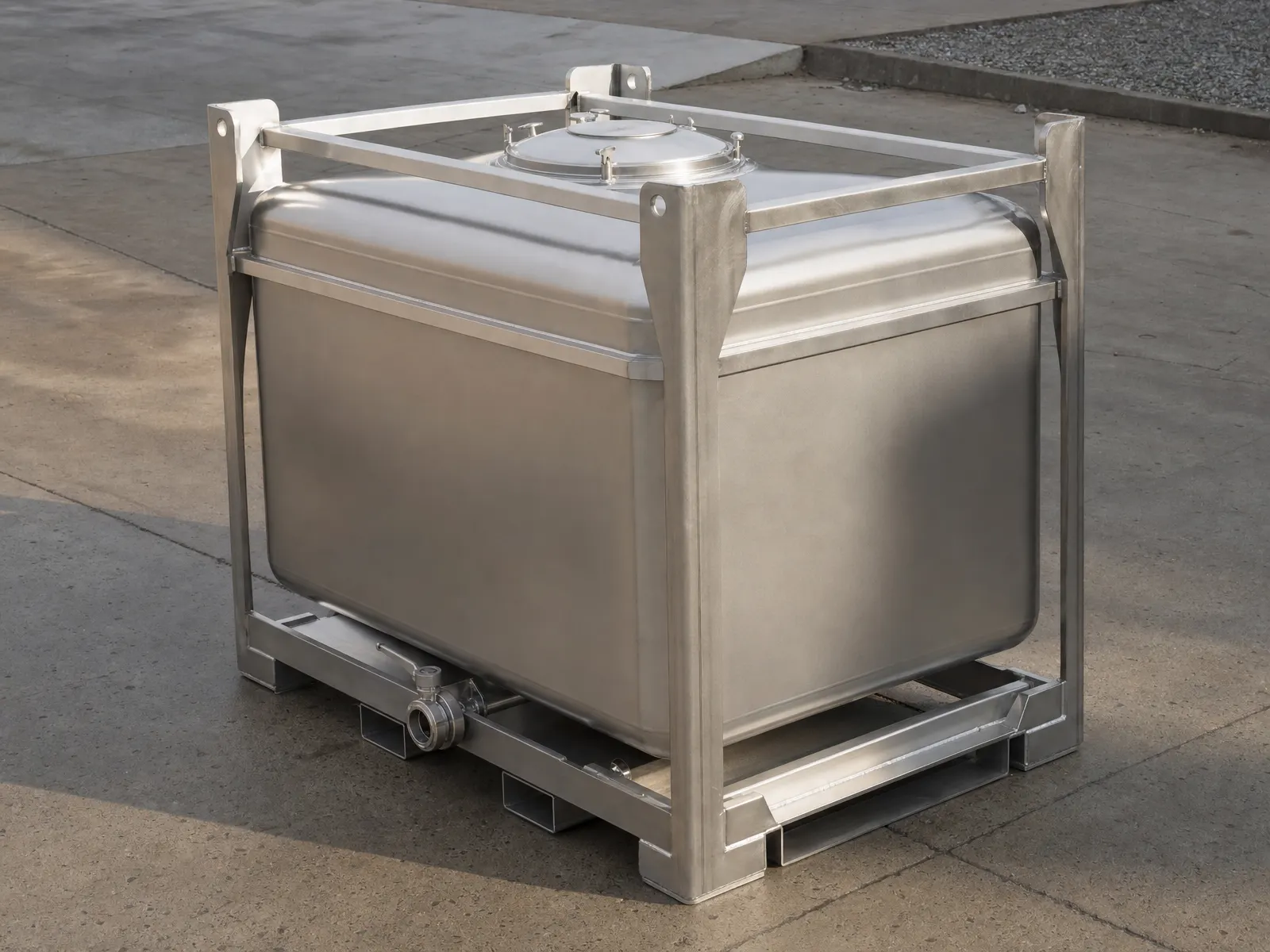
A 350 gallon 304 stainless IBC of 10 gauge (0.135 in) wall weighs about 475 lb empty (Snyder LiquiTote). Carbon steel IBCs are in the same range, depending on gauge and design. Both are built to be refilled for years and to come back: a damaged steel body can be repaired and returned to service after retesting (49 CFR 180.352(d)), and the periodic internal inspection checks the wall is still at its minimum thickness. If your containers go out one-way, a steel IBC is rarely the economical choice.
Cleaning between uses
Steel IBCs are bought to be used many times, so think about cleaning before you buy. Stainless can be washed with hot water, caustic and acid, steam, and the chemicals food and pharmaceutical plants use for clean-in-place, without damage to the shell. A polished interior finish sheds product and is easier to inspect. Spray balls fitted through the manway reach the whole shell.
Carbon steel is usually kept in one service, because cleaning it to a standard fit for a different product is harder, and water left inside starts rust. Drain it fully, dry it, and keep it closed. For both metals, the gaskets and valve seats are the parts most likely to hold traces of the last product; replace them when changing service.
Linings and coatings
Between bare carbon steel and stainless sit lined steel IBCs, with an epoxy or phenolic coating on the inside to keep the product off the metal. A lining can widen the products a carbon steel IBC carries, but it is only as good as its condition: a chip or scratch exposes steel, and some solvents attack some linings. Ask the maker which products the lining is rated for, and inspect it at every cleaning.
Short answers
- Is stainless or carbon steel better for diesel?
- Carbon steel suits diesel and fuels well, as long as water is drained from the bottom. Stainless costs more and adds little for fuels.
- Is a stainless IBC food grade?
- 304 and 316 stainless are standard materials for food equipment. Check the valve, gaskets and any sight tube are food-contact too.
- What is the difference between 304 and 316 stainless?
- 316 contains molybdenum, which improves resistance to chlorides and some acids. It costs more.
- Can stainless IBCs go through a tote wash?
- Yes. Industrial tote washers clean stainless IBCs with hot water, detergents and caustic; ask the washer to record the cleaning on the IBC’s file.
- Will stainless rust?
- It resists rust, but chlorides, some acids and trapped moisture under dirt can pit it. Rinse and dry it after use.
- Which is lighter?
- Weight follows the design and wall thickness more than the metal; both steels are far heavier than a caged composite tote.
- Do steel IBCs need painting?
- Carbon steel shells are usually painted outside to resist rust. Stainless is normally left bare.
The totes this bears on
- Stainless steel IBC totesNew 304 stainless IBCs in 350 and 550 gallons and up: gauge, finish, UN31A, tare and gross weights, fittings. Quoted on request.Steel: 304, 10 gauge · Finish: 2B · UN code: 31A · Sizes: 350, 550, 793 gal
- Carbon steel and metal IBCsNew carbon steel IBCs rated UN31A: when a steel IBC is required, how carbon steel differs from stainless, and how to ask for a price.Build: Carbon steel shell · UN code: 31A · Approval: often UL 142 · For: Class I flammables
- 350 gallon stainless steel IBCThe 350 gallon 304 stainless IBC: about 475 lb tare, 6,030 lb max gross, UN31A, top manway and bottom valve. Specs and a delivered quote.Capacity: 350 gal / about 1,325 L · Tare: about 475 lb · Max gross: 6,030 lb · UN code: 31A
- 550 gallon IBCs550 gallon IBCs, mostly built in stainless or carbon steel and rated UN31A: who uses the large size, how many fit a trailer and how we quote it.Capacity: 550 gal / about 2,082 L · Build: Stainless or carbon steel · UN code: 31A · Per trailer: about 30 large IBCs
Read next: UN31A steel IBCs, Flammable liquids, Weight, empty and full.